
Bones break and joints dislocate in predictable workplace situations: falls from height or ladders, getting caught between objects, being struck by something falling, or being thrown around in a vehicle incident. Your job as a first aider isn’t to set the bone or reduce the dislocation. It’s to stop the injury getting worse, control any associated bleeding, and keep the patient stable for the ambulance.
A fracture is a break or crack in a bone. Closed fractures leave the skin intact. Open (compound) fractures involve the bone breaking through the skin, which adds a serious infection risk and usually a bleeding problem. A dislocation is when the bones meeting at a joint are forced out of normal alignment. The shoulder, fingers, kneecap and jaw are common dislocation sites. You often can’t tell from looking whether something is a fracture, a dislocation, or both, so when in doubt, treat as a fracture. You won’t cause harm by being cautious.
Recognising a fracture
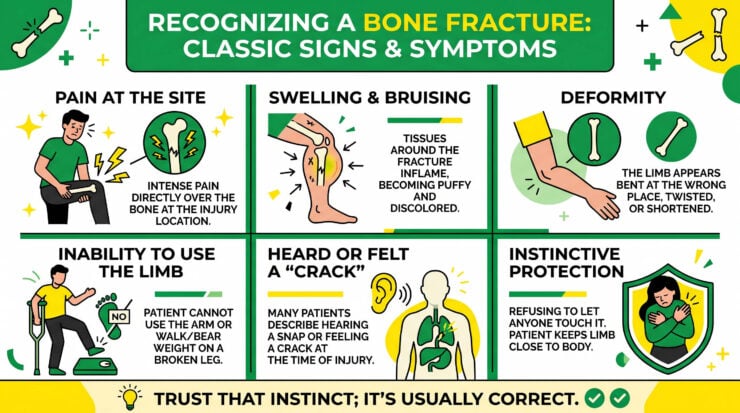
The classic signs are pain at the site, swelling and bruising, deformity (the limb looks bent at the wrong place or shortened), and inability to use the limb or bear weight. The patient may have heard or felt a crack at the time. They may protect the limb instinctively, holding it close to their body, refusing to let anyone touch it. Trust that instinct; it’s usually correct.
Larger bone fractures can cause significant internal bleeding even when the skin is intact. A fractured femur (thigh bone) can lose a litre of blood into the surrounding tissue. A fractured pelvis can lose two or three litres. These are shock-producing injuries even without visible blood. Monitor accordingly.
Open fractures
Open fractures need urgent medical care because of the infection risk and the likelihood of significant blood loss. Control the bleeding by applying pressure around the wound, not directly on the protruding bone end. Don’t try to push the bone back under the skin. Cover the wound with a sterile non-stick dressing if you have one, or a clean cloth, and call 111.
What to do
Tell the patient not to move the injured area. If they’re holding it themselves in a position that feels manageable, let them. Patients in pain almost always find the position that hurts least, and that’s usually the position you want them to stay in until paramedics arrive.
If they need help supporting the injury, immobilise it by holding above and below the fracture site, or by packing rolled-up clothing, towels or padding around the limb to stop movement. The goal is preventing movement, not splinting in any formal sense and definitely not straightening the limb. ANZCOR and ANZ Resuscitation guidance is clear: don’t straighten an angulated fracture and don’t reduce a dislocation. Both can damage blood vessels and nerves, and both belong to people with x-rays and analgesia.
Check circulation below the injury. Is the skin warm? Can the patient feel you touching their fingers or toes? Can they wiggle them? Compare to the uninjured side. Cold, pale, blue, numb, or unable-to-move below the injury site is urgent. The bone may be pressing on a major blood vessel or nerve. If circulation is compromised, call 111 if you haven’t already, and tell the dispatcher specifically: “Fracture with no circulation below it.”
When to call 111
Call 111 for any open fracture; any fracture or dislocation where circulation or sensation below the injury is compromised; suspected pelvis, hip or femur fractures (these patients should not be moved); spinal or neck injuries; any injury that can’t safely be transported by car; and any situation where you’re not confident managing it yourself.
For less severe injuries (a suspected broken finger, a wrist that’s clearly hurt but stable, a small bone), transport to an urgent care or emergency department by car is usually fine. Use judgement. If transporting them is going to involve significant pain or movement of the injury, an ambulance is the better choice.
Splints: usually unnecessary
You may have learned to apply formal splints in older first aid training. Splints are usually unnecessary if professional help is close. Splinting requires moving the limb, which causes pain and risks further damage. The exception is remote work where the patient has to be transported a significant distance over rough ground. In that case, padded improvised splints (rolled magazines, cardboard, rolled blankets) wide enough and long enough to span the joints above and below the fracture can reduce pain during transport. For most workplace incidents in towns and cities, immobilise where they are and wait for the ambulance.
A workplace scenario
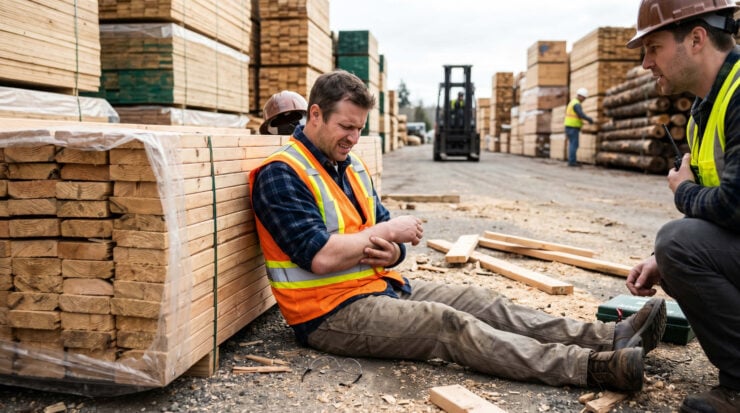
A timber yard worker trips over some boards laid haphazardly on the ground. He falls on his outstretched arm. He’s sitting on the ground cradling his forearm, which has a visible kink in it just above the wrist. He’s pale and shaky.
The yard supervisor reaches him within a minute. He tells him not to move the arm and to keep holding it the way he’s holding it. He sends another worker to call 111 with the address and gate number.
At this point, he could use a folded jacket under his forearm to support the weight. He checks his fingers: warm, pink, he can wiggle them slightly. Good. He checks about pain elsewhere (the worker says no), and keeps him sitting still.
When the paramedics arrive he hands over: “Tripped landing on his right arm, visible swelling and angulation just above the wrist, fingers warm and pink, sensation intact, no other injuries he’s aware of. Has been holding it himself the whole time.” It’s concise, accurate, and saves the paramedics a couple of minutes of questions. The worker gets to hospital with a stable, well-supported fracture and no additional damage from movement.


Darren has written over 3000 articles about driving and vehicles, plus almost 500 vehicle reviews and numerous driving courses. Connect with him on LinkedIn by clicking the name above