
How can you save money on fuel? Use less. Here are some tips – more than 40 of them! You should be able to save at least 10%.
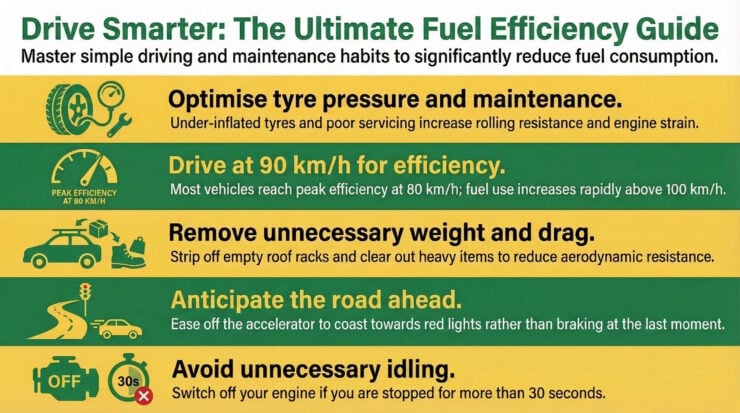
- Keep your tyres inflated to the correct pressure. Under-inflated tyres increase rolling resistance significantly.
- Remove anything from the vehicle you don’t need to carry around; the lighter the car, the less fuel it burns.
- Take roof racks and bike carriers off when they’re not in use as they create aerodynamic drag even when empty.
- Drive at 90 km/h rather than 100 km/h on the open road. This doesn’t impact your journey time too much. Most modern vehicles reach peak fuel efficiency around 80km/h and fuel consumption rapidly increases above that.
- Open the windows rather than use air conditioning where practical, and park in the shade to reduce how hot the cabin gets before you drive.
- Switch to Eco mode if your vehicle has it, and use the fuel economy display on the dashboard to monitor your habits in real time.
- Don’t leave your engine idling. If you’re going to be stopped for more than 30 seconds, turn it off.
- Read the road ahead: if you can see a red light in the distance, ease off and coast up to it rather than braking hard at the last moment.
- Don’t tailgate because following too closely forces constant small speed adjustments that waste fuel.
- Keep your vehicle well serviced: use the correct grade of engine oil, replace the air and fuel filters, change spark plugs on schedule, maintain fuel injectors, and fix any dragging brakes.
- In wet weather, avoid driving through puddles because they create additional drag on the vehicle.
- Carpool where you can (sharing a trip means sharing the fuel cost),
- Walk or cycle for trips under a kilometre.
- Cover the tray of your ute or the deck of your truck; an open tray creates significant aerodynamic drag.
- When approaching a roundabout, time your entry so you can keep rolling rather than coming to a full stop because restarting from a standstill costs more fuel.
- If your schedule allows, shift your commute outside of peak hours to avoid stop-start traffic. Or work from home one day a week.
- Take it easy when the engine is cold. Cold engines burn more fuel, so avoid hard acceleration until the engine has warmed up.
- Reverse into car parks rather than reversing out. Slow manoeuvring on a cold engine uses a lot more fuel.
- In a truck, use block shifting (skipping gears) to get into the highest appropriate gear as quickly as possible.
- If your truck or trailer has a tag axle, raise it when you don’t need all the wheels on the ground; fewer wheels rolling means less rolling resistance.
- Set your roof kit correctly for your trailer so that air flows over the trailer rather than smacking into the front of the trailer
- Install cab vanes on your tractor unit
- If you have an adjustable 5th wheel, run the trailer as close as you can to the cab without it hitting the cab – a shorter gap means less aerodynamic resistance
- Apps like Gaspy can help you find the cheapest fuel in your area.
- Get a wheel alignment; misaligned wheels increase rolling resistance and cause uneven tyre wear.
- Use cruise control on the open road to maintain a steady speed.
- Drive in the highest gear that’s appropriate for your speed and conditions.
- Use smooth, gradual throttle inputs rather than sharp acceleration.
- Avoid unnecessary overtaking; the time you gain is often minimal relative to the fuel you spend.
- Choose routes with fewer traffic lights and stop signs where practical.
- Combine errands into single trips rather than making several separate journeys. For example, stopping for groceries on the way home from work rather than making a second trip out is more efficient.
- Where you have a choice, take flatter routes because hills cost fuel. (We’re not telling you to move to Christchurch, but some routes are considerably more hilly than others.)
- Distribute your load evenly because an unbalanced load makes the vehicle work harder.
- If you need new tyres, consider low-rolling-resistance (eco) tyres.
- Modern vehicles only need a few seconds to warm up – there’s no need for extended idling before you set off.
- Build up speed before you reach a hill, not on it, then hold a steady throttle on the climb – it’s more efficient than trying to accelerate up the slope.
- Let gravity do the work on the way down. Ease off the accelerator and use your momentum rather than fighting it with the brakes.
- Consider keeping your tank at half rather than full. A full tank of petrol adds around 30–40 kg, though the benefit of running lighter is modest.
- Don’t carry passengers you don’t need to, unless you’re all carpooling, of course.
- Take the first car park you find, even if it means a slightly longer walk. The time and fuel spent circling for a closer spot rarely pays off.
- Switch off electrical accessories you’re not using as they all draw on the alternator and put load on the engine.
- Avoid driving into strong headwinds where you have a choice – wind resistance at higher speeds has a meaningful impact on fuel consumption.
- Carry a little more speed through corners (safely) to reduce the amount of braking and re-accelerating you need to do.
- Keep your cool behind the wheel. Road rage and aggressive driving is inefficient driving
- Do SAFED (Safe and Fuel Efficient Driving) training – click here to find out where.
- Google Maps often shows you the route with the best projected fuel economy. This might not be the shortest route, but it’s all about the savings.
- A final bonus one about fuel use in general: protect your fuel. Use a lockable fuel cap so your fuel can’t be siphoned.
You might also find some useful driving techniques in the following online courses:
Driving in Difficult Conditions
You could also consider in-vehicle coaching, such as this option.


Darren has written over 3000 articles about driving and vehicles, plus almost 500 vehicle reviews and numerous driving courses. Connect with him on LinkedIn by clicking the name above