
Here’s a statistic that might surprise you: a significant number of injuries to truck drivers, forklift operators, and heavy machinery operators happen before they even start the engine.
It’s not the driving that gets them. It’s getting in and out.
Climbing into a truck cab, stepping down from a forklift, mounting and dismounting excavators and loaders: these are routine actions that operators perform dozens of times a day. And because they’re routine, they’re often rushed. Because they’re familiar, they’re often careless.
But the combination of height, awkward angles, variable conditions, and fatigue makes cab access one of the most underestimated injury risks in transport and logistics.
Why Getting In and Out Is Riskier Than You Think
Think about what’s involved in climbing into a vehicle’s cab. You’re stepping up onto surfaces that might be wet, muddy, or icy. You’re gripping handholds that might be slippery or poorly positioned. You’re hauling your body weight up at an awkward angle, often while tired, often in a hurry.
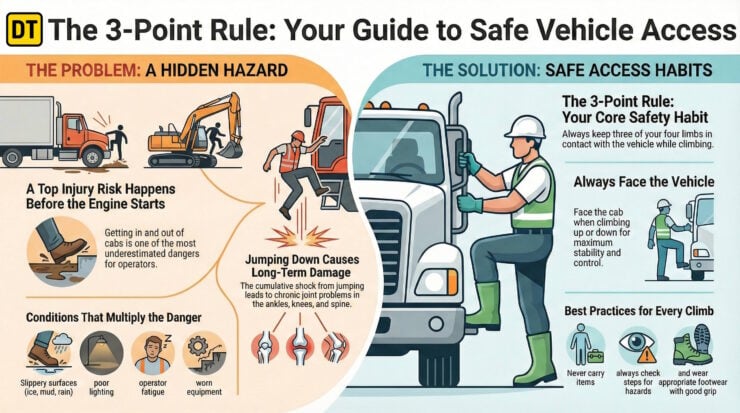
Now think about getting down. The temptation to jump rather than climb is real, especially when you’re in a rush. But jumping down from cab height sends a shock through your ankles, knees, and spine that your body isn’t designed to absorb repeatedly. Do that a few times a day, every day, for years, and you’re setting yourself up for joint problems.
Forklift operators face similar issues. The cabs aren’t as high, but the access is often awkward – stepping over controls, squeezing into tight spaces, twisting to get in and out. Excavator and loader operators deal with even greater heights and more exposed access points, often in muddy or uneven conditions.
And then there’s the truck deck. Climbing onto a flatbed to fasten chains, secure tarps, or check loads involves all the same risks, plus the added hazard of working on an elevated surface that wasn’t designed for walking around on. One risk assessment example I’ve seen rated “climbing on the truck deck to fasten chains” with a severity score of 5 out of 5 for the risk of slipping off (we cover this in our heavy vehicle load security course). That’s about as serious as it gets.
The Three Points of Contact Rule
The single most important principle for safe cab access is maintaining three points of contact at all times. That means three of your four limbs should be in contact with the vehicle, either gripping or standing on something secure, while the fourth limb moves.
Two hands and one foot. Or two feet and one hand. Always three points.
This sounds simple, and it is. But it requires you to slow down and be deliberate about your movements. It’s incompatible with jumping down. It’s incompatible with carrying things while you climb. It’s incompatible with rushing.
And that’s exactly why people don’t do it. When you’re running behind schedule, when you’ve done it a thousand times before, when you’re just ducking into the cab to grab something, that’s when the three points rule gets abandoned. That’s when injuries happen.
The Conditions That Catch People Out
Access hazards get worse when conditions deteriorate, and conditions in the real world are rarely ideal.
Wet weather makes steps and handholds slippery. Mud gets tracked onto surfaces and builds up on boot soles. Ice in winter can turn a routine dismount into a fall. Even morning dew can make metal steps treacherous.
Poor lighting is another factor. Early morning starts and late finishes mean operators are often climbing in and out in the dark. If the steps and handholds aren’t where you expect them to be (or if there’s an obstacle you can’t see) you’re in trouble.
Then there’s the equipment itself. Worn steps, loose handrails, missing grip tape, damaged running boards; these things don’t get fixed until someone gets hurt. And some equipment is simply poorly designed for access, with steps too far apart, handholds in awkward positions, or cabs that require contortions to enter.
The Fatigue Factor
There’s another element that doesn’t get talked about enough: fatigue.
Operators are often at their most tired at exactly the moments when they’re getting in and out of vehicles. At the end of a long shift. After hours of driving. When they’ve been loading or unloading and their muscles are already fatigued.
Tired people make poor decisions. They take shortcuts. Their reaction times are slower. Their grip strength is reduced. Their balance is compromised.
That final dismount at the end of the day – when you’re exhausted and just want to get home – is statistically one of the most dangerous moments of your shift.
What Good Practice Looks Like
For operators, safe access comes down to a few key habits.
Always use the three points of contact rule. No exceptions. No matter how rushed you are, no matter how many times you’ve done it before.
Face the vehicle when mounting and dismounting. Climbing down backwards, facing the cab, gives you much better control than turning around and stepping down forwards. Yes, it feels slower. That’s the point.
Never jump down. Even from relatively low heights, the cumulative impact on your joints adds up. Climb down properly every time.
Check your access points before you use them. A quick glance at the steps and handholds takes a second and can reveal hazards – mud, ice, damage – before they catch you out.
Don’t carry things while climbing. If you need to take something up or down, find another way. Use a bag you can sling over your shoulder. Pass items to someone else. Make a second trip. Don’t compromise your grip.
Wear appropriate footwear. Boots with good grip make a real difference on wet or muddy surfaces. Worn-out soles are a fall waiting to happen.
What Operators and Businesses Can Do
For businesses running fleets, cab access is worth taking seriously as a safety issue.
Inspect access points regularly. Steps, handholds, grip surfaces, and running boards should be part of your pre-start checks and maintenance schedules. Damage or wear should be fixed promptly, not left until the next service.
Consider the equipment you’re buying. Some vehicles and machinery are better designed for access than others. Steps that are appropriately spaced, handholds that are well-positioned, cabs that don’t require awkward contortions; these things matter for long-term injury prevention.
Think about the environment. If your yard or site is consistently muddy, can you improve drainage or provide better surfaces around where vehicles are parked? If operators are climbing in and out in the dark, is the lighting adequate?
Include access hazards in your training. Don’t assume everyone knows the three points of contact rule—or that they’re actually using it. Make it part of induction and reinforcement.
The Injury That Doesn’t Look Like an Injury
One of the tricky things about cab access injuries is that they don’t always present as dramatic incidents. A fall from a truck cab is obvious. But the cumulative damage from years of jumping down, the gradual wear on knees and ankles, the back strain from twisting awkwardly; these things develop slowly.
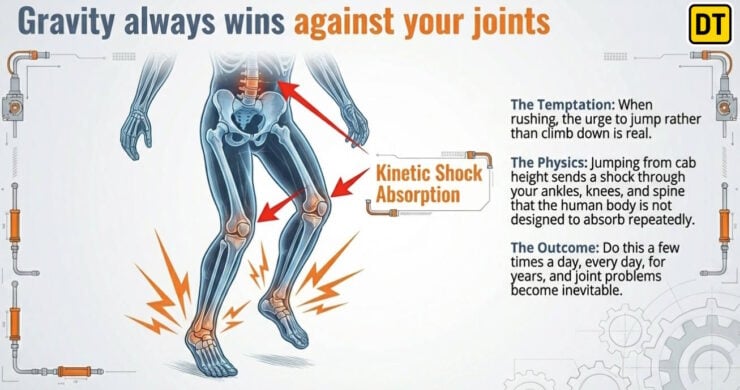
By the time they become a problem, it’s hard to point to a single cause. But the cause is there: thousands of small compromises, accumulated over time.
The good news is that this is one of the more preventable categories of workplace injury. The controls are simple. The habits aren’t hard to develop. It just requires taking seriously something that feels too routine to be dangerous.
Your cab access might be the most hazardous part of your day. Treat it that way.


Darren has written over 3000 articles about driving and vehicles, plus almost 500 vehicle reviews and numerous driving courses. Connect with him on LinkedIn by clicking the name above