Your hazardous substances inventory: what it must include and who needs to see it
Many workplaces have a list of the chemicals they hold, usually a spreadsheet someone set up years ago. That list isn’t necessarily an inventory in the legal sense. If it doesn’t match what’s on your shelves today, it won’t help anyone in an emergency.
What must a hazardous substances inventory include?
For each hazardous substance, you need:
- the product or chemical name, and the UN number if it has one (section 14 of the safety data sheet)
- the maximum amount likely to be at the workplace
- its location
- any specific storage and segregation requirements (sections 7 and 10 of the SDS)
- a current SDS, or a condensed version of the key information such as a product safety card.
The maximum amount is the one most sites get wrong. It isn’t what’s on the shelf the day you do the stocktake; it’s the peak, e.g. the week a container lands or the run-up to a large dispatch.
Yes. The Health and Safety at Work (Hazardous Substances) Regulations 2017 require a PCBU (Person Conducting a Business or Undertaking) with a workplace where hazardous substances are present to keep an inventory of every hazardous substance used, handled, manufactured or stored there. There’s no minimum quantity; one 20 L drum of degreaser in the corner of the workshop counts.
The exemptions are narrow. You don’t need an inventory if the only hazardous substances on site are consumer products in household quantities, e.g. cleaning products bought at the supermarket. Transit depots are also exempt, because goods in transit stay in their packaging and fall under the Land Transport Rule: Dangerous Goods 2005. However, a transit depot must still be able to give emergency services a list of what it holds and how much. If you store stock rather than hold it briefly between legs of a journey, don’t assume the transit exemption applies to you.
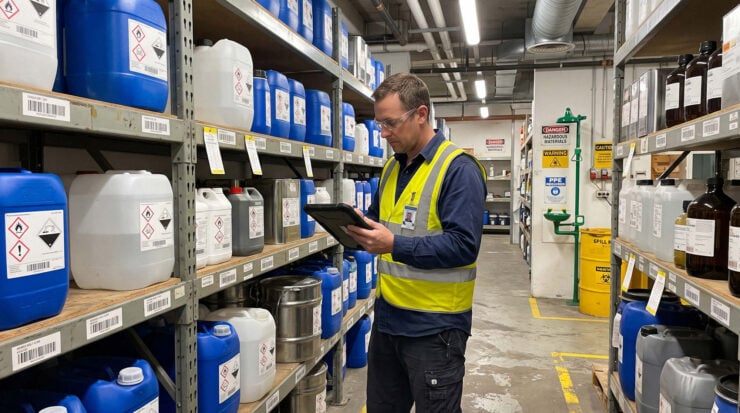
Yes, and it’s often left off. Waste with explosive, flammable, oxidising, toxic or corrosive properties must be listed with a description that identifies it as closely as possible (e.g. “chlorinated solvent waste”), the maximum quantity, its location and its storage and segregation requirements. Waste doesn’t need an SDS. In a warehouse, this typically means contaminated absorbent from spill clean-ups and damaged containers set aside for disposal.
WorkSafe’s inventory template also includes the hazard classification, UN class and packing group, physical state and, for flammable liquids, container size and whether the containers are open or closed. These aren’t mandatory fields, but they decide which controls apply to you. For example, a location compliance certificate is needed for flammable liquids if you store 50 L or more in open containers, 100 L or more in closed containers larger than 5 L, or 250 L or more in closed containers of 5 L or less. A single pallet of 20 L drums of solvent is well past that.
At the workplace, where emergency services can get to it, including after the building has been evacuated. A spreadsheet on the office PC fails that test if the office is inside the evacuated building. Keep a printed copy with your emergency response plan somewhere fire crews can reach from outside, and keep an electronic backup. You can also give a copy to your local Fire and Emergency New Zealand station.
No. They do need access to the SDSs and must understand the safety information in them, which is covered in the DG Handler course.
Whenever the information in it changes. That includes a new product, a change to the maximum amount, moving a substance to a different location, or a supplier updating an SDS with new storage or segregation advice. The regulations don’t set a fixed review date, so the practical approach is to tie updates to your receiving process. Then a new product code triggers an inventory check before the stock is put away.
When you update the inventory, check your controls at the same time. A new substance may need secondary containment, different signage or a different storage location.
WorkSafe’s Hazardous Substances Calculator lets you enter your substances, saves them as an inventory and tells you which controls apply. It gives you a PIN to access the inventory later, and WorkSafe can’t reset it. Email the PIN to yourself and record it where others can find it, otherwise the inventory leaves the business with whoever set it up.
Your spill kit should match what’s on your inventory. The absorbents need to suit the substances you hold (e.g. acids, alkalis or hydrocarbons), and the kit needs enough capacity for your largest container. If you add a new substance or start holding larger quantities, check the spill kit still covers them. Our Spill Control and Spill Kit Training course covers choosing a kit and using it correctly.


Darren has written over 3000 articles about driving and vehicles, plus almost 500 vehicle reviews and numerous driving courses. Connect with him on LinkedIn by clicking the name above