
• A TR Group Site
  • Help
  • Cart
Driving Tests DT logo small
Driving tests
  • Learner licence
    • Car
    • Motorbike
    • Heavy vehicle
    • Learner Licence Plus
  • Courses
  • Tourist
  • Resources
  • Learn
  • Resources
  • Learner licence
    • Car
    • Motorbike
    • Heavy Vehicle
    • Learner Licence Plus
  • Your courses
    • Enrolled courses
  • View all courses
  • Tourist
  • Resources home
  • iOS application
  • Android application
  • Contact us
  • Terms and conditions
  • Privacy
  • Home
  • /
  • Resources
  • /
  • Advice
  • / The spill hazard you might miss: fumes heavier than air

The spill hazard you might miss: fumes heavier than air

Many commonly used workplace chemicals give off vapours or fumes that are heavier than air, meaning they can sink, spread along floors, and accumulate in low areas such as pits, drains, sumps, basements, or inside vehicles and containers. This makes them especially dangerous for asphyxiation, fire, or explosion risk.

Below is a practical, safety-focused list grouped by chemical type.
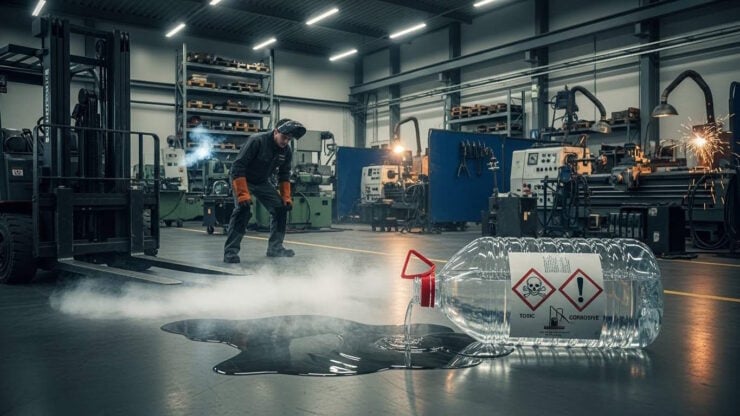
The danger is that you might not see the fumes, and in low-ventilation areas, they can hang around for ages.

Common Chemicals with Vapours Heavier Than Air

Fuels & Petroleum Products

These are very common in transport, workshops, and yards.

  • Petrol (gasoline)
  • Diesel fuel
  • Kerosene
  • Aviation fuel
  • Heating oil
  • Mineral spirits / white spirits

There is a high fire and explosion risk; vapours can travel long distances to ignition sources.

Solvents

Widely used in cleaning, degreasing, painting, and manufacturing.

  • Acetone
  • Toluene
  • Xylene
  • Methyl ethyl ketone (MEK)
  • Isopropyl alcohol (IPA)
  • Methanol
  • Ethanol
  • Trichloroethylene
  • Perchloroethylene (PERC)

Vapours can build up in enclosed or poorly ventilated areas.

Refrigerants & Gases

Often overlooked because many are colourless and odourless.

  • Carbon dioxide (CO₂)
  • Propane
  • Butane
  • LPG (liquefied petroleum gas)
  • Refrigerants such as R134a, R404A, ammonia alternatives

CO₂ is not flammable but can displace oxygen and cause sudden unconsciousness.

Industrial & Toxic Chemicals

Less common but very hazardous.

  • Hydrogen sulfide (H₂S)
  • Chlorine
  • Sulfur dioxide
  • Carbon tetrachloride
  • Ethylene dichloride

Extremely dangerous at low concentrations, often fatal without warning.

Paints, Coatings & Adhesives

Common in workshops, panel shops, and construction.

  • Paint thinners
  • Epoxy hardeners
  • Spray paints
  • Contact adhesives
  • Resins

Spray application greatly increases airborne vapour concentration.

Why “Heavier Than Air” Matters

  • Vapours pool at ground level
  • They linger longer than lighter gases
  • Normal ventilation may be ineffective
  • Ignition sources at floor level (forklifts, static sparks, drains) increase risk
  • Workers may walk into dangerous concentrations unknowingly

Key Safety Controls

  • Use low-level ventilation where required
  • Keep ignition sources away from floor level
  • Never rely on smell alone
  • Store chemicals correctly and keep lids sealed
  • Have spill kits suitable for chemicals, not just oil
  • Spill control training should include vapour behaviour, not just liquid and solid spills
By Darren Cottingham

Darren has written over 3000 articles about driving and vehicles, plus almost 500 vehicle reviews and numerous driving courses. Connect with him on LinkedIn by clicking the name above

‹ The economics of gantry crane ownership vs. leasing or financing
Neck pain in crane operators: an overlooked risk ›
Posted in Advice, Dangerous goods
Recent Resources
  • Issuing a permit to work: scope, inspection and isolation
  • Interpreting Manufacturer Load Capacity Specifications
  • PPE, safety equipment and hazardous substances in permitted work
  • How to find your real driving triggers (and why most drivers get it wrong)
  • PPE Requirements for Truck Loader Crane Operators and Ground Crew
  • Atmospheric testing for Permit Issuers as part of the permit to work system
  • The pre-drive routine: why the first few minutes of your driving shift matter most
  • What are outriggers or straddle legs on a forklift or electric pallet jack?
  • Preparing the worksite
  • What is a forklift paper roll clamp, and how does it work?

Licences and Courses

  • Car
  • Motorbike
  • Heavy Vehicles
Car
  • Core
  • Behaviour
  • Parking
  • Emergencies
  • Road position
  • Intersection
  • Theory
  • Signs
Motorbike
  • Bike-specific questions
  • Core
  • Behaviour
  • Parking
  • Emergencies
  • Road position
  • Intersection
  • Theory
  • Signs
Heavy Vehicles
  • Class 2
  • Class 3-5
  • Core
  • Behaviour
  • Parking
  • Emergencies
  • Road position
  • Intersection
  • Theory
  • Signs

Vehicle and workplace training

  • About
  • Resources
DT Driver Training TR Group
About
  • About us
  • Contact us
  • Privacy Policy
  • Terms and Conditions
Resources
  • Homepage
  • Driving Tests Android App
  • Driving Tests iPhone App
  • Getting your learner licence
DT Driver Training TR Group
Copyright 2010-2026 DT Driver Training Ltd, PO Box 12541, Penrose, Auckland, 1642. All rights reserved. Questions and images are used with permission from NZTA; question answers are proprietary.