In recent years, we have witnessed significant advancements in gantry crane design, particularly for specialised industries where standard lifting solutions are insufficient.
Safety-Oriented Design Features
Overload protection systems have become increasingly sophisticated, with load moment indicators that constantly calculate the weight being lifted and its distance from the crane’s tipping axis. These systems provide real-time feedback to operators and can automatically prevent operations that would exceed the crane’s rated capacity.
Anti-collision technology has also evolved significantly, with advanced systems using laser, infrared, or radio frequency technology to prevent cranes from colliding with each other or with fixed obstacles. This is particularly valuable in crowded industrial environments where multiple cranes may operate in close proximity, such as shipyards and manufacturing facilities.
Emergency stop functions have been enhanced with redundant systems, ensuring immediate shutdown of all crane functions in case of an emergency. Modern designs also incorporate fail-safe mechanisms that automatically engage brakes in the event of power failure, ensuring loads remain secure even in unexpected situations.
Automation and Remote Operation
One of the most transformative trends in gantry crane design is the move towards automation and remote operation. Remote controls that allow operators to position themselves optimally for better visibility of the load and the surrounding area are now the standard.
In highly specialised industries such as nuclear facilities, ports, and hazardous material handling, fully automated gantry cranes are becoming more common. These systems use a combination of sensors, cameras, and computer algorithms to perform lifting operations with minimal human intervention. The benefits include increased precision, reduced risk to human operators, and the ability to operate in environments that would be dangerous or inaccessible to humans.
Semi-automated systems represent a middle ground, where computers assist human operators by optimising lift paths, preventing dangerous operations, and providing enhanced feedback. These systems combine the flexibility and judgement of human operators with the precision and consistency of computerised control. Operators still need gantry crane training, but guardrails are in place to minimise risks.
Environmental Adaptations
Specialised industries often operate in challenging environments that require purpose-built gantry crane designs. For offshore and marine applications, cranes must withstand corrosive saltwater environments, high winds, and wave motion. This has led to developments in corrosion-resistant materials, enhanced stability systems, and designs that can compensate for vessel movement.
In extreme temperature environments, such as foundries or cold storage facilities, specialised gantry cranes incorporate materials and components rated for these conditions. High-temperature environments require special consideration for lubricants, electrical systems, and operator comfort, while cold environments present challenges related to material brittleness and increased energy consumption.
For industries with potential explosion risks, such as petrochemical facilities, intrinsically safe gantry crane designs have been developed. These systems eliminate potential ignition sources through specialised electrical components, non-sparking materials, and temperature controls.
Customised Load Handling
Different industries have unique load-handling requirements that have driven innovations in gantry crane attachments and configurations. The steel industry has seen advancements in specialised lifting magnets and tongs for handling hot materials and awkwardly shaped loads.
Container handling operations utilise telescopic spreaders that can adjust to different container sizes, while the precast concrete industry employs custom lifting frames designed to handle specific panel configurations.
Multi-function gantry cranes are becoming more common, with the ability to switch between different load-handling devices quickly. This versatility is particularly valuable in manufacturing settings where a variety of materials and components must be handled.
The forestry and timber processing industries have benefitted from specialised grapple systems that can handle logs of varying dimensions efficiently. Meanwhile, the aerospace industry utilises precision handling systems that can manipulate delicate components with extremely tight tolerances.
Energy Efficiency and Sustainability
Environmental considerations have become increasingly important in gantry crane design. Energy-efficient motors and drives are now standard in new cranes, reducing power consumption and operational costs. Regenerative braking systems, which recover energy during lowering operations, are becoming more common in high-duty cycle applications.
Variable frequency drives (VFDs) allow for smoother acceleration and deceleration, reducing peak power demands and mechanical stress on the crane. This technology not only saves energy but also extends the service life of the equipment and reduces maintenance requirements.
Solar-powered gantry cranes are emerging in some applications, particularly in remote locations or where grid power is unreliable. While currently limited to smaller-capacity cranes, this technology shows promise for reducing the carbon footprint of lifting operations.
Smart Monitoring and Predictive Maintenance
The integration of Internet of Things (IoT) technology has revolutionised maintenance approaches for gantry cranes in specialised industries, and AI applications are rapidly evolving. Modern cranes incorporate numerous sensors that monitor critical components and operating parameters, collecting data that can be analysed to predict potential failures before they occur.
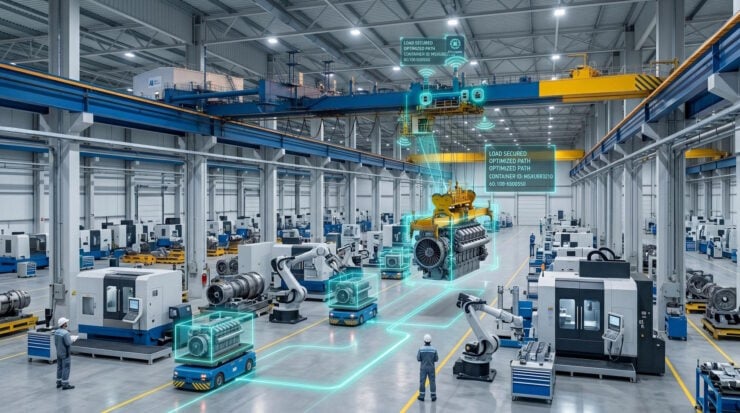
These smart monitoring systems track variables such as motor temperature, bearing wear, rope condition, and structural stress. The data is processed using sophisticated algorithms that can identify patterns indicating developing problems, allowing maintenance to be scheduled proactively rather than reactively.
Remote monitoring capabilities enable crane manufacturers and service providers to assess equipment health from off-site locations, providing valuable insights to equipment owners. This approach has proven particularly valuable in industries where unplanned downtime carries significant financial penalties, such as port operations and continuous production facilities.
Ergonomics and Operator Experience
The human factor remains crucial in gantry crane operations, despite increasing automation. Significant attention is now being paid to operator comfort and control interface design. Modern operator cabins feature improved visibility, climate control, reduced noise levels, and ergonomic seating to reduce fatigue during long operating periods.
Control systems have become more intuitive, with user interfaces designed based on human factors research. Touch screens, joysticks, and programmable function buttons allow for customisation according to operator preferences and specific task requirements.
Augmented reality (AR) interfaces are beginning to appear in some specialised applications, overlaying critical information directly onto the operator’s field of view. This technology can display load weight, crane capacity at the current radius, proximity warnings, and suggested movement paths.
Integration with Broader Systems
Modern gantry cranes in specialised industries increasingly function as components of larger integrated systems rather than as standalone equipment. In automated warehouses and distribution centres, gantry cranes coordinate with conveyor systems, automated guided vehicles, and warehouse management software to optimise material flow.
Manufacturing facilities are integrating gantry cranes with production planning systems, allowing lifting operations to be scheduled and sequenced according to production needs. This integration enables just-in-time delivery of components to production cells, reducing work-in-progress inventory and improving overall efficiency.
Port operations represent perhaps the most advanced example of system integration, with ship-to-shore gantry cranes working in concert with yard cranes, automated transport vehicles, and terminal operating systems to minimise vessel turnaround times and maximise throughput.
AI use will continue to grow, with vision-guided automation, smart scheduling and self-diagnosis.


Darren has written over 3000 articles about driving and vehicles, plus almost 500 vehicle reviews and numerous driving courses. Connect with him on LinkedIn by clicking the name above